
ABOUT PRODUCT
JB Engineering DCP-Anchors
JB Engineering’s Double Corrosion Protection (DCP) Anchors are hot-dip zinc and fusion epoxy coating, provide superior corrosion resistance with a service life of up to 100 years.The system incorporates two independent protective barriers along with grouted corrugated sheathing, making it ideal for permanent applications such as high-rise construction and heavy reinforcement works.
DCP anchors provide active structural restraint by applying controlled compressive forces, reducing movement and enhancing stability. They are available in various configurations to suit different project requirements.
Widely used in densely populated urban areas, these anchors support construction where space is limited. Options such as removable anchors and resizable composite anchors offer added flexibility for future developments, including tunneling projects.
JB Engineering’s (DCP) – DOUBLE CORROSION PROTECTION Anchors classifies as like below: The application of ground anchors is increasing as they enable construction in densely populated areas. This increase is due to the reductions in available space for traditional construction methods. In areas of limited easement, removable anchors can be used. For projects where further underground construction, like adjacent developments of tunnels is anticipated engineers can use resized anchors produced from composite materials.

Hot Zinc Coated / Fusion Epoxy Coated anchors provide minimum 100 Years Corrosion Protection.

Bond length and free length to enable pre-stressing.

Capacities: bars 4,500 kN, strand 15,900 kN(+)

Anchors with diameter range12-75mm strand anchors up to 63mm(+)

Full compatibility with infrastructure intelligence, utilizing multiple sensor types.
JB Engineering Pre-stressed grounds Double Corrosion Protection (DCP) Anchors are HOT DIP ZINC Coated & Fusion EPOXY COATED provides protection from Corrosion for Minimum 100 Years & more actively contribute to the stability of a structure throughout its design life.
Stressing jacks are used to pre-stress the anchor and elongate the tendon. Once the necessary load has been established, the anchor is locked off at the head. The anchor then applies a compressive load to the structure to arrest movement.
Stressing jacks are used to pre-stress the anchor and elongate the tendon. Once the necessary load has been established, the anchor is locked off at the head. The anchor then applies a compressive load to the structure to arrest movement.
Stressing jacks are used to pre-stress the anchor and elongate the tendon. Once the necessary load has been established, the anchor is locked off at the head. The anchor then applies a compressive load to the structure to arrest movement.

Uplift Control

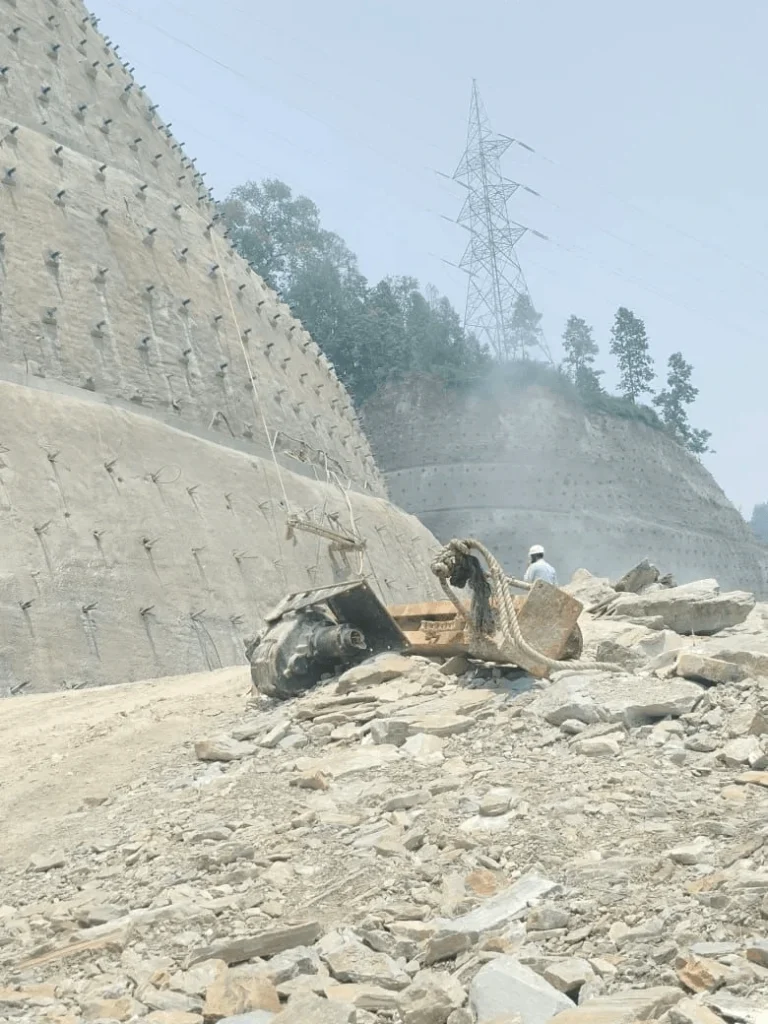
Rock Stabilization

Toe Stabilization

Positional Stability

Hard rock mining

Coal mining

Geotechnical and Shoreline

Bridges

General construction

Civil construction

Infrastructure & Tunnels

Dams
Anchors are drilled to depth, and the tendon is placed inside a corrugated sheath
A stressful jack elongates the tendon. Once the required load is reached, the anchor is locked off at the head, applying a compressive load to stabilize the structure
Free length load transfer allows controlled elongation
Bond length load transfer is grouted to the ground for load transfer
The unbonded zone prevents premature load transfer and ensures full elongation before resistance occurs. This results in superior structural integrity
JB Engineering integrates advanced smart technologies into its Double Corrosion Protection (DCP) Anchors to enhance performance, safety, and long-term structural monitoring. These intelligent systems are designed to provide real-time insights and ensure optimal functionality throughout the anchor’s lifecycle.
Every JB Engineering DCP Anchor is produced under strict quality control procedures to ensure:
- Dimensional accuracy
- Corrosion protection compliance
- Load-bearing reliability
- Controlled crack width performance
- Long service life
We supply to infrastructure, metro rail, hydropower, and major engineering contractors across India and international markets.
01. What is a DCP Anchor?
A DCP Anchor is a Double Corrosion Protection ground anchor system designed for long-term structural reinforcement.
02. What is the load capacity?
Bar anchors up to 4,500 kN and strand anchors up to 15,900 kN.
03. Where are DCP Anchors used?
Used in deep excavations, retaining walls, tunnels, dams, and infrastructure projects.
04. What ensures 100+ years service life?
Dual corrosion protection using Hot Dip Zinc and Fusion Epoxy coating systems.
05. Can DCP Anchors be monitored?
Yes, they are compatible with sensor-based structural monitoring systems.